
Furniture Panels for Large Fit-Outs: What Specifiers Ask
A large fit-out lives or dies on panel consistency: hundreds of identical components cut from boards that must match in thickness, face and glue class. Dongstar Wood's commercial range covers furniture plywood, hardwood plywood and veneer plywood across four core options and five named face veneers, with 18 mm the published choice for heavy-duty furniture and structural panels.
Key takeaways
- Thickness drives the specification: cabinet backs and drawer bottoms at 6–9 mm, desks, shelves and hotel fixtures at 12–15 mm, heavy-duty pieces and structural panels at 18 mm.
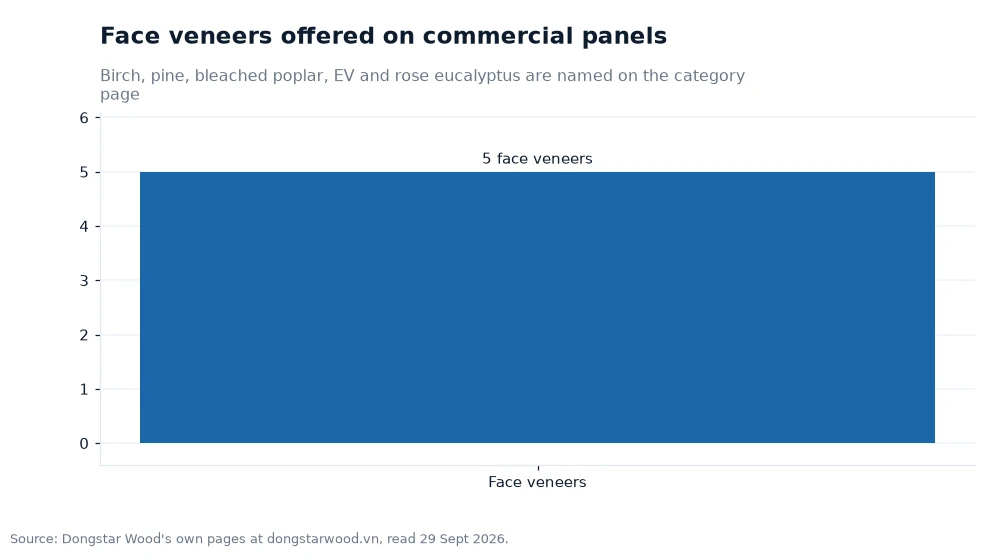
- Five face veneers are named on the category page: Birch, Pine, Bleached Poplar, EV and Rose Eucalyptus.
- Four cores are offered — Acacia, Bodhi, Eucalyptus and Combi — so strength, weight and cost can be balanced per project.
- MR glue suits dry interiors while BWR handles humidity and light water exposure; the EU range is marketed with No Anti-Dumping Tax.
What a fit-out specification actually contains
Specifiers working on office furniture, kitchen cabinets, retail display fixtures, hotel interiors and partition systems tend to write the same five lines: face veneer, core, thickness, glue grade and size. Everything else — finish, edge treatment, packaging — hangs off those five decisions. The category page names its specialism as furniture plywood, hardwood plywood and veneer plywood; OEM and custom plywood solutions sit alongside the standard panels.
Mass-production furniture manufacturing is listed among the applications, which tells you the range is designed around repeatable batches rather than one-off pieces. A fit-out that needs 400 identical cabinet carcasses cares less about a spectacular face and more about the 400th board matching the first.
Face veneers: the five named options
The published face veneers are Birch, Pine, Bleached Poplar, EV and Rose Eucalyptus. Birch gives a pale, uniform surface that takes stain and lacquer evenly. Pine is the economical choice for painted components where the face is covered anyway. Bleached poplar lightens a panel without changing its handling, while EV and Rose Eucalyptus sit at the decorative end for visible surfaces in retail and hotel interiors.
Choosing between them is a finish decision as much as a structural one. A specifier who plans to paint will not pay for a decorative veneer; a specifier who plans to leave the face visible will not accept colour variation across a run. The five options exist so that the face can be matched to the finishing process rather than the other way round. The options are published on the category page, so a specifier can confirm the current availability of each veneer before writing it into a bill of materials.
Cores and thickness: where the load goes
Four cores are offered: Acacia Core, Bodhi Core, Eucalyptus Core and Combi Core. Acacia provides high density and load-bearing capacity, Eucalyptus Core adds compression resistance and bending strength, and the Combi Core hybrid strikes a balance between strength, weight and cost. The white hardwood choice, Bodhi Core, is described as stable with balanced mechanical strength and a cost-performance pitch.
Thickness guidance is explicit: cabinet backs, drawer bottoms and partitions belong in the 6–9 mm band; office furniture, shelves and hotel fixtures in the 12–15 mm band; heavy-duty furniture, worktops and structural panels in the 18 mm band. Contractors often standardise 12 mm and 18 mm, which simplifies procurement because two thicknesses cover most of a programme. Since the same 18 mm sheet can be built on different cores, the specification should name the core explicitly rather than assuming a default.
Glue grades for interior work
Two glue classes dominate interior specification. MR, short for Moisture Resistant, is the standard for dry interiors — offices, retail, hotels — where the panel never meets liquid. BWR stands for Boiling Water Resistant and is the step up for humidity and light water exposure; it is the sensible choice for kitchen cabinets and any component that will be cleaned regularly.
The distinction matters at the quotation stage because it changes the adhesive system, not the veneer. Specifying MR for a kitchen means ordering a panel whose glue class will fail in the moisture it actually faces, and that failure surfaces months after installation rather than at the inspection.
The EU value case
Six reasons for EU customers are listed on the category page: competitive pricing for wholesale distribution, supply that is more affordable and cost-effective than Chinese factories, flexible minimums with fast delivery to Europe, strong quality control at each production stage, a stable monthly supply, and custom size, core structure, glue, face veneer and grade. Dongstar Wood states No Anti-Dumping Tax for European and US shipments, which is a landed-cost argument as much as a price one.
Quality control is described as in-house lab testing from raw materials to export batch, so the checks happen inside the factory rather than at a third-party office. For a fit-out contractor, that means a batch can be traced back through the press rather than argued about after delivery.
| Specification line | Published option | Typical fit-out use |
|---|---|---|
| Face veneers | Birch, Pine, Bleached Poplar, EV, Rose Eucalyptus | Visible surfaces, painted components |
| Cores | Acacia, Bodhi, Eucalyptus, Combi | Load-bearing versus cost balance |
| Thickness | 6–9 / 12–15 / 18 mm | Carcasses, furniture, worktops |
| Glue grades | MR, BWR | Dry interiors, humid rooms |
| Duty position | No Anti-Dumping Tax | EU and US shipments |
Worked example: panel area for a cabinet run
Area arithmetic prevents both shortages and waste. A fit-out needs 200 sheets of 1250 × 2500 mm board; at 3.125 m² per sheet (1.25 m × 2.5 m), the order is 200 × 3.125 = 625 m² of panel. If the cutting list yields 90% usable area per sheet, the effective coverage is 625 × 0.9 = 562.5 m², and the offcut budget is the remaining 62.5 m².
The same arithmetic checks thickness against the cutting plan. A programme standardised on 18 mm for carcasses and 12 mm for backs can be ordered as two clean batches rather than a mixed pile, which keeps the press settings — and the glue cure — consistent within each batch.
Frequently asked questions
Which thickness should a specifier choose for office furniture?
The published guidance puts office furniture, shelves and hotel fixtures at 12–15 mm, with 18 mm reserved for heavy-duty furniture, worktops and structural panels. Contractors often standardise on 12 mm and 18 mm so that two thicknesses cover most of a programme.
What is the difference between MR and BWR glue?
MR is moisture resistant and suits dry interiors such as offices and retail. BWR is boiling water resistant and handles humidity and light water exposure, which makes it the better choice for kitchen cabinets and components that are cleaned regularly.
Can the face veneer and core be customised?
Yes. The category page lists custom size, core structure, glue, face veneer and grade among the options, alongside OEM and custom plywood solutions for mass-production furniture manufacturing.
Writing the specification
A fit-out specification is short once the five lines are fixed. Check the Commercial Plywood category page for the current face and core options, then confirm the company profile for the factory figures behind them. Where the design also calls for a clear-finished visible face, the birch range covers the decorative duty. Specifiers who write the five lines before asking for a quotation tend to receive answers they can compare.
Data points in this article originate with the vendor's online documentation consulted on 29 September 2026[1].